Guggenheim heir settles in Abu Dhabi ahead of museum
A family name finds a new home as Saadiyat Island prepares to open its doors
When Dillon Lawson-Johnston moved to Abu Dhabi with his wife and two children, he became the only member of the Guggenheim family living in the city whose new museum will carry his family’s name. That fact has never left his mind. “I think there’s a huge sense of responsibility for me to represent the family in a certain way as we continue to figure out what’s next,” he says.
His arrival traces back to the museum project itself. He first visited Abu Dhabi through the effort to establish a Guggenheim there, and found himself drawn to the country’s long-term cultural ambitions. “Guggenheim Abu Dhabi was my entry point,” he says. “It was my introduction to this place, and the reason I started spending time here, and that really opened my eyes to the people here, the country itself, the ambition of the leadership.”
The museum at the center of that journey opens on December 11. Developed through a partnership between the Department of Culture and Tourism Abu Dhabi and the Solomon R Guggenheim Foundation, its Gehry-designed building on Saadiyat Island will be the largest in the Guggenheim network, housing art from the 1960s onwards with an emphasis on work from West Asia, North Africa and South Asia. Lawson-Johnston expects it to feel both local and connected. “Abu Dhabi itself will need to feel distinctly like it’s from Abu Dhabi, and it will,” he says. “But it’s also part of a larger cultural dialogue.”
He is well placed to take part in that dialogue. Through the Wanasa Circle, he shares observations about emerging artists and developments in those regions with curators in New York; the group advises and supports their work, while curators make the decisions about acquisitions. On the Young Collectors Council, also in New York, he joins discussions about programmes that bring younger audiences into museums. He and his wife Chloe were among the co-chairs of its 2025 fund-raising party, which supported the museum and the council’s art fund.
His professional life has followed a parallel path. After working at Untitled Entertainment and the talent agency UTA, he co-founded the investment firm Guggenheim Brothers Media in 2024. The UAE’s investment in creative industries encouraged him to explore building the business there, and conversations led to a partnership with Abu Dhabi’s Ethmar International Holding, announced in January. He decided to settle in the city.
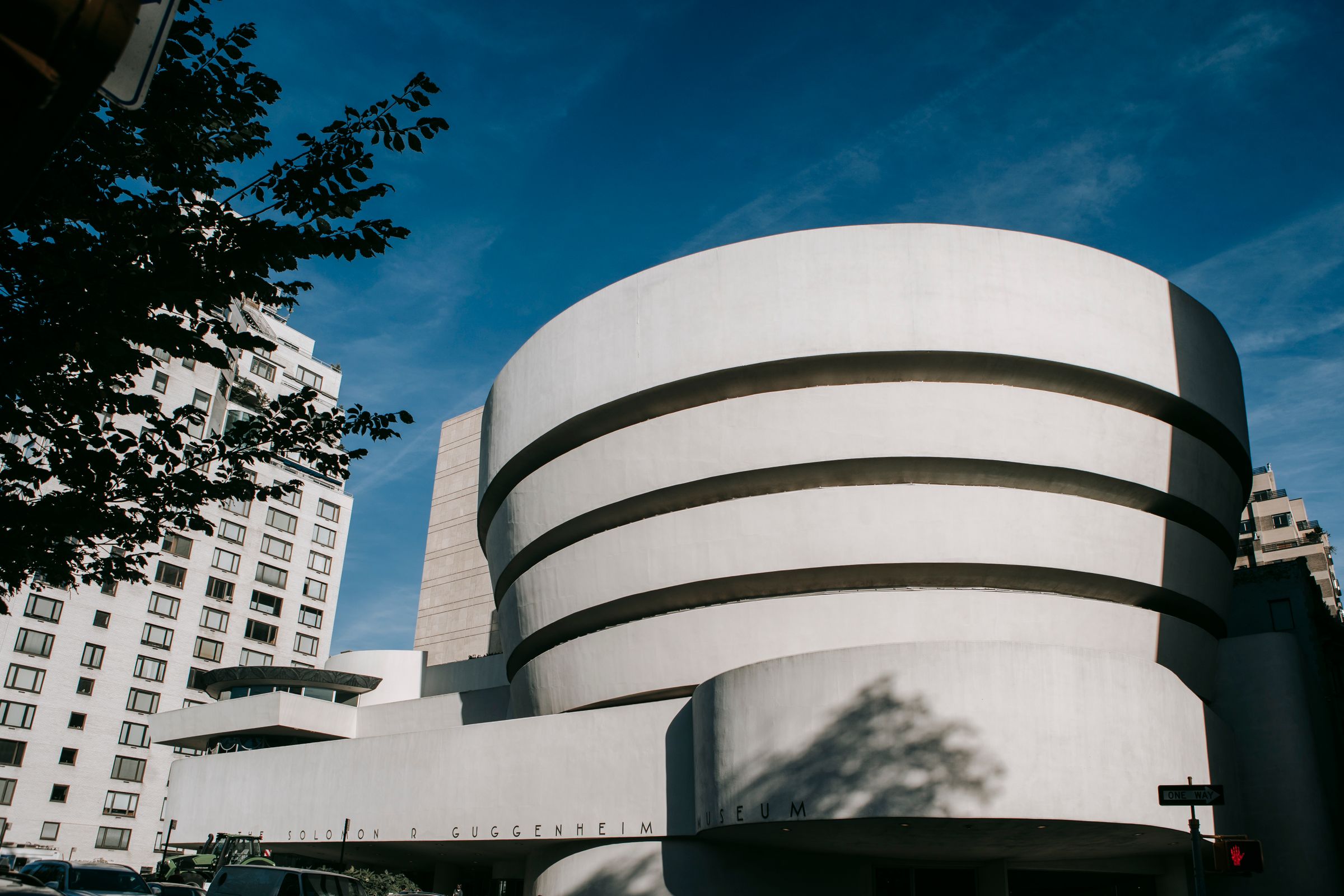
The family name he carries has shaped modern art for nearly a century. In the 1920s, mining magnate Solomon R Guggenheim began buying abstract paintings with the encouragement of the artist Hilla Rebay, assembling a collection that would eventually need a home of its own. That home arrived in 1959, a decade after Solomon’s death, in Frank Lloyd Wright’s New York museum, which holds many works by Wassily Kandinsky. By then, Solomon’s niece Peggy had settled in Venice, opening her home and collection to visitors.
Peggy’s support had been integral to artists struggling to make a living. In 1943, she offered Jackson Pollock $150 a month against future sales, allowing him to leave his job as a museum custodian and paint full-time. She gave him his first solo exhibition at her New York gallery, Art of This Century, and commissioned Mural for the entrance to her home.
The institution’s ambitions eventually stretched beyond those collections. In 1997, its Frank Gehry-designed museum opened in Bilbao, helping transform the Spanish city into an international destination for art. An agreement to establish a museum in Abu Dhabi followed in 2006, bringing the institution to a region whose artists would form an important part of its collection.
Lawson-Johnston credits his grandfather Peter Lawson-Johnston, a former president and chairman of the foundation, with that expansion. “I’ve spent a lot of time with him, and he really was the one who championed Bilbao and Abu Dhabi,” he says. “I think a lot of people don’t know that, but he was the one who really took the risk to do that.” His grandfather believed a museum could help change a city’s cultural life.
Lawson-Johnston grew up visiting the Guggenheim in New York, but only in his 20s did he begin looking closely at the history behind it. What interested him was how his relatives had recognised talented people and given them the support to pursue their work, a pattern he saw extending beyond art into fields such as aviation and publishing. Whatever his own path would be, he knew he had to be bold. “I don’t want to just be a passive inheritor of a name,” he says. “I want to play a very meaningful role in what the Guggenheim name will mean in the future.”
His ambitions for the museum concern what happens once visitors walk through its doors. He expects people to come from around the world, and wants to help younger Emiratis and other UAE residents develop a lasting relationship with the institution through its programmes and changing exhibitions. His entertainment background has made him interested in how an encounter online can lead someone to seek out an artist or visit a physical space; one idea he would like to pursue is inviting digital creators to spend time in the museum and share what they find with their followers. “I think cultural programming is huge,” he says. “We live in a world now where the next generation is experiencing culture digitally before they ever experience it in real life.” He adds: “I’m just trying to be a strategic partner where I can around how we can drive the next generation into the museum and engage with it.”
He also sees scope in how the family’s work has evolved, from collecting to supporting artists to building institutions, each widening the ways people could encounter art. He does not describe himself as a major collector, but wants to help more people take part in cultural life. “Being engaged with the arts does not have to be focused around collecting per se,” he says. “It can be supporting creatives, being part of a community. It can be figuring out how next generations engage or creating access.”
Above all, he wants to tell the story behind the institution. “I want to be a champion of telling the family story,” he says. “I think when you start to learn more about the history of the family and the ambitions and how it all came together, you’re more inclined to go and spend time there and feel like you’re connected. There’s a certain sense of belonging.” The family’s journey, from Solomon’s 1920s collecting to a museum opening on Saadiyat Island, is traced in further detail at https://www.thenationalnews.com/arts-culture/art-design/2026/10/29/next-generation-of-guggenheim-family-finds-home-in-abu-dhabi/
Q&A
Who is Dillon Lawson-Johnston and why is he in Abu Dhabi?
He is the only member of the Guggenheim family living in Abu Dhabi, where he moved with his wife Chloe and their two children. He first visited through the effort to establish a Guggenheim museum there, which he calls his entry point to the country, and he decided to settle in the city.
When does Guggenheim Abu Dhabi open and what will it feature?
It opens on December 11 on Saadiyat Island. The Frank Gehry-designed building, developed with the Department of Culture and Tourism Abu Dhabi and the Solomon R Guggenheim Foundation, will be the largest in the Guggenheim network, housing art from the 1960s onwards with an emphasis on work from West Asia, North Africa and South Asia.
How does Lawson-Johnston stay involved with the Guggenheim institution?
Through the Wanasa Circle he shares observations about emerging artists and developments in West Asia, North Africa and South Asia with curators in New York, who make acquisition decisions. He also sits on the Young Collectors Council in New York, and he and his wife Chloe co-chaired its 2025 fund-raising party supporting the museum and the council's art fund.
What role did his grandfather play in the family's museum story?
Peter Lawson-Johnston, a former president and chairman of the foundation, championed the expansions to Bilbao and Abu Dhabi, according to his grandson. He believed a museum could help change a city's cultural life, and Lawson-Johnston says his grandfather took the risk to make those projects happen.